
Parentification Resource Center
Early-Onset Dementia and the Caregiver Cliff
Dementia tends to get filed, in most people’s imaginations, under “old age.” It belongs to people in their late seventies or eighties, long after their kids have moved out and the big financial responsibilities of raising a family are behind them. That’s part of why it hits so differently when memory loss, disorientation, or a significant personality shift shows up instead in someone’s 40s or 50s, during the exact years they’re still raising teenagers, still paying a mortgage, still the adult that other adults in the family lean on.
When early-onset dementia arrives, a family doesn’t just lose someone’s memory. They can lose a functioning parent and a functioning income at the same time. That’s the setup in which a teenager or young adult often quietly becomes the household’s second adult, sometimes before anyone outside the family realizes anything has changed at all.
What “Early-Onset” Actually Means
Clinically, dementia is generally called early-onset, or younger-onset, when symptoms begin before age 65. The age line itself is somewhat arbitrary, biology doesn’t change dramatically between 64 and 66, but it matters enormously for how surprising the diagnosis feels and for how few services are built to catch it. It’s also broader than the word “Alzheimer’s” alone suggests. Some people develop frontotemporal dementia, which tends to affect behavior and language before memory. Others develop dementia with Lewy bodies, which can change attention, movement, and sleep. From inside the family, the exact label on a scan usually matters less than the shared consequence: a parent in midlife begins doing things that make daily life less safe or less reliable, at an age most systems aren’t designed to expect.


What It Looks Like in a Kitchen, Not a Clinic
Early-onset dementia often announces itself through small, jarring breaches of competence rather than a single dramatic event. A parent who has always driven the same route suddenly takes a wrong turn, or misses one entirely. Bills that used to be handled automatically start arriving late, because the parent can no longer remember an online password. The same question gets asked three times within an hour. Food gets left on the stove. A parent who used to run the whole family’s schedule suddenly forgets to pick up a younger sibling.
These aren’t dramatic neurological events from the outside. They’re the kind of thing you only notice if you actually live in the house.
And often, the people who notice most clearly are the kids. They’re in the car when the turn is missed. They’re the ones fielding the school’s attendance calls the parent didn’t excuse. They start reminding, cueing, correcting, and then, almost without realizing the shift, they start covering: “My mom is tired.” “We had an appointment.” That covering is usually the exact moment a role reversal begins, because the young person isn’t just helping anymore. They’re protecting the parent’s standing in the outside world.
The Cliff Itself
For a while, families in this situation compensate. A spouse works more hours. A teenager reminds more often. An older sibling starts stopping by on weekends. Then, often quite suddenly, there’s a fall: the parent forgets a child somewhere, wanders, becomes disinhibited in public, or discloses something private to a stranger. That’s usually the moment a school, an employer, or a neighbor realizes something has been wrong for a while, and the family has to admit how long they’ve actually been managing this alone.
We call this the caregiver cliff: a period where everything looks fine right up until it very suddenly doesn’t. The drop tends to be especially steep in early-onset cases specifically because the parent still looks young and healthy. Teachers and employers don’t always immediately believe “dementia” when they’re looking at someone in their early 50s who drove themselves to the meeting. Even some clinicians will consider stress or depression before considering a neurodegenerative process. During that gap, between a family already knowing and a system finally acknowledging it, a young person is often the one holding daily life together.


Why the Timing Makes This So Much Harder
If dementia arrives at 82, the likely caregiver is often a spouse in their late seventies, someone with authority, financial standing, and decades of adult experience navigating systems. If it arrives at 52, the person most consistently present in the home is frequently a teenager, with none of that authority and none of that experience. The tasks themselves don’t change. Medication still has to be managed. Appointments still have to be kept. But the person doing them is also supposed to be doing algebra homework, showing up for a first job, or getting to practice on time.
This is also the point where administrative complications tend to pile up. Because the parent is younger, they’re often still in the workforce when cognitive decline starts affecting performance, missed deadlines, errors, friction with coworkers. Disability and insurance pathways built around older claimants can be slower and more complicated for younger cases. While the adults in the family are stuck working through unfamiliar forms and appeals, someone still has to keep daily life moving. Often, that someone is a teenager emailing teachers, calling a bus company, or rescheduling a medical appointment between classes.
Why Existing Support Systems Often Miss This
Most dementia-specific support, from caregiver handbooks to respite programs, is built with a spouse caregiver in mind: someone in their 60s or 70s who drives, controls the household, and can take time off work. A 15-year-old can’t do most of that. Even programs that technically welcome “family” participation often have practical blockers built in: sessions scheduled during school hours, no transportation offered, or a teenager who’s simply afraid of saying too much out of fear it will trigger an unwanted intervention.
There’s also a believability problem. Teachers, employers, and sometimes even health workers don’t always immediately accept “my mom has dementia” coming from a teenager, particularly when the parent is young, presents well, and can speak fluently in short bursts. That disbelief tends to push young caregivers to compensate even further, making up schoolwork at night when an absence isn’t excused, or accompanying a parent to every appointment just to make sure the story gets told accurately.
By the time anyone outside the home fully realizes a dementia case is being held together by a child, that child has often been managing practical care, emotional regulation, and administrative paperwork for months or years already.
What Families Facing This Should Know
Early-onset dementia is not a parenting failure. It’s a medical event that happens to arrive at an unusually difficult stage of family life. The World Health Organization describes dementia broadly as a term covering several diseases that worsen over time, reflecting physical changes in the brain rather than any choice a parent or family made.
Recognizing that this is a health crisis, not a character issue in either the parent or the child compensating for them, is the first step toward getting a family the kind of support it actually needs, rather than the kind built for a very different caregiving situation.
If There Are Younger Children in the Home Too
Families facing early-onset dementia often include children at very different developmental stages, a teenager quietly managing medication alongside a much younger sibling who’s just old enough to notice a grandparent, aunt, or parent is changing. If your family is also navigating how to explain memory loss to a younger child, our Parent Discovery Resource Center offers age-specific language and support for that side of the conversation.
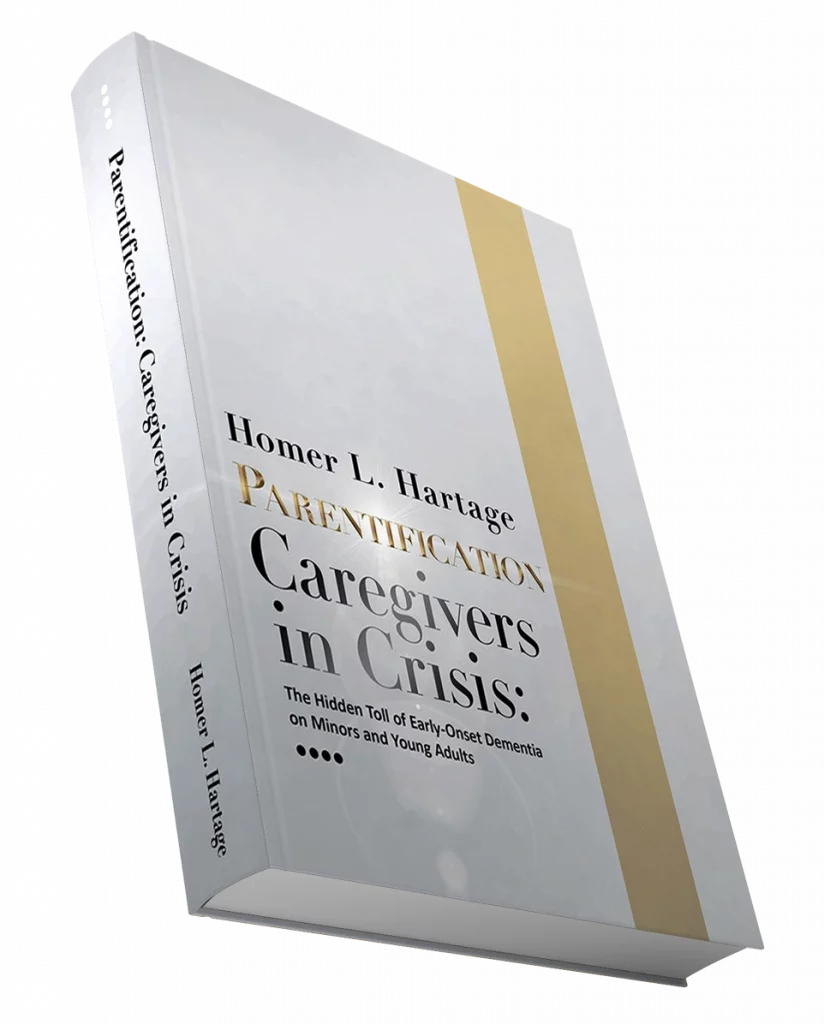
Parentification: Caregivers In Crisis
Every day, countless children step into roles meant for adults. Behind that strength lies a hidden cost: the loss of childhood, unspoken stress, and emotional wounds that can last a lifetime.
When Children Carry Adult Responsibilities
This book shines an unflinching light on the emotional and psychological weight carried by children who are forced to grow up too soon.