
Parentification Resource Center
What Is Parentification? Understanding the Hidden Role Reversal
When a teenager is the one who knows a parent’s appointment schedule, answers calls from the clinic, moves money between accounts, and explains to school staff why “my mom can’t make it today,” the adults around them often reach for the same word: responsible. It sounds like praise. In many cases, it’s actually a description of a young person quietly covering a gap in adult functioning.
That pattern has a name in the clinical literature: parentification. Naming it matters, because unnamed, it looks like maturity and gets rewarded. Named, it can be recognized, limited, and supported.
The Basic Definition
Parentification is a role reversal. A teenager or young adult takes on caregiving, household, or emotional work that would normally belong to a parent, and does it not for a few difficult days, but over months or years. It tends to show up when an adult’s capacity is missing, impaired, or pulled away, by illness, mental health struggles, addiction, or, in the context this resource center focuses on, early-onset dementia.
Two features tend to separate parentification from ordinary family helping:
It goes on and on. This isn’t “Mom had surgery, so I cooked dinner for a week.” It’s a pattern that stretches for months or years, often without a clear endpoint in sight.
It isn’t matched to the young person’s age. A 16-year-old occasionally driving a parent to a doctor’s appointment is a reasonable request. A 12-year-old managing a parent’s online banking because the parent can no longer remember passwords is not.


Two Kinds of Parentification
Researchers typically split parentification into two categories, and understanding both matters, because they don’t look the same from the outside.
Instrumental parentification is the visible, practical side of the role reversal: cooking, supervising younger siblings, translating at medical appointments, calling the insurance company, sorting a parent’s medication, paying bills online. Because this kind of caregiving is visible and often looks organized, adults around the family may actually underestimate how much it’s costing the young person doing it.
Emotional parentification is the invisible side: soothing a parent who is confused, ashamed, or suddenly angry; absorbing an adult’s fears about money, housing, or the future; becoming the one person a parent feels safe being honest with; quietly managing the parent’s dignity in front of other people. This side tends to be the heavier lift. It requires a young person to suppress their own feelings, almost constantly, to make room for an adult’s.
Most concerning situations involve both at once, layered on top of each other for a long stretch of time. That combination, instrumental plus emotional plus chronic, is the pattern most consistently linked to difficulties later in life: anxiety, low mood, and strained relationships in adulthood.
Where This Idea Came From
Parentification isn’t a new concept invented for dementia specifically. Family-systems researchers were describing children who became “parental” as far back as the 1960s through 1980s, usually in households where one or both adults weren’t fully available for some other reason. Later research put a formal name and measurement tools to the pattern.
What’s different in an early-onset dementia household is the specific timing. This disease knocks out an adult’s executive function, the ability to plan, remember, and manage daily responsibility, during the exact years that children still live at home and depend on that functioning. Meals still need making. Bills still need paying. Medication still needs sorting. If there isn’t another fully available adult in the house, the most competent young person in the home tends to get quietly recruited into the role, whether anyone intends for that to happen or not.


Two Dials Worth Checking: Fairness and Fit
Not every child who pitches in is at risk, and it’s worth being careful not to pathologize every instance of a teenager helping out at home. Two questions tend to separate healthy contribution from a genuine concern:
Fairness. Is the young person’s contribution recognized, shared with other adults, and limited in time? Or are they the only one keeping the household functional, without real acknowledgment?
Developmental fit. Is this something a person of that age can reasonably do without losing sleep, school time, or safety?
When a young person’s contribution is shared and appropriately matched to their age, it can even be growth-promoting. When it’s unshared, open-ended, and mismatched to what a young person should be handling, it becomes a genuine risk.
Five Signs Helping Has Crossed a Line
Research on parentification tends to circle around the same cluster of warning signs. When several of these are present together, a family has likely moved from ordinary contribution into a riskier role reversal:
- Duration, the young person has been doing adult-level tasks for months or years, not through a discrete crisis.
- Exclusivity, the teenager is the only one doing it, with no other adult sharing or rotating the responsibility.
- Secrecy, the young person is actively hiding the parent’s condition from school, neighbors, or even doctors.
- Exposure to adult problems, the young person is present for, or handling, adult-level concerns like paying a mortgage, applying for disability, or deciding what to sell to keep the lights on.
- Impact on the young person’s own life, school attendance, sleep, social life, or health are visibly bending around the caregiving, rather than the caregiving fitting around a normal adolescence.
The more of these that show up at once, the more likely a family is dealing with parentification rather than simple helping. Because early-onset dementia is both progressive and deeply personal, families affected by it can find themselves checking every one of these boxes far sooner than families facing other kinds of illness.
Why Kids Rarely Say Anything
One of the reasons parentification stays hidden, in surveys, in schools, and in families themselves, is that young people usually have real, rational reasons to stay quiet:
- They love the parent and don’t want them to be embarrassed or exposed.
- Fear of family separation. Many young people worry that telling a teacher “Mom forgets everything” will trigger a report and result in the family being broken apart.
- Normalized burden. If a young person has been helping since age 11, by 16 it can simply feel like ordinary life, not something worth mentioning.
The practical result: the more burdened a young person actually is, the less likely they are to signal it clearly. That’s exactly why recognition has to start with the adults around them, not with waiting for the young person to ask.
What to Do With This Information
If you’re a parent, relative, teacher, or friend and this description sounds familiar, the next right step isn’t a dramatic intervention. It’s a closer look. Our article Signs Your Teenager May Be a Young Caregiver walks through the specific, practical clues worth watching for at home, and Early-Onset Dementia and the Caregiver Cliff explains why this particular disease creates the conditions for parentification to happen especially fast.
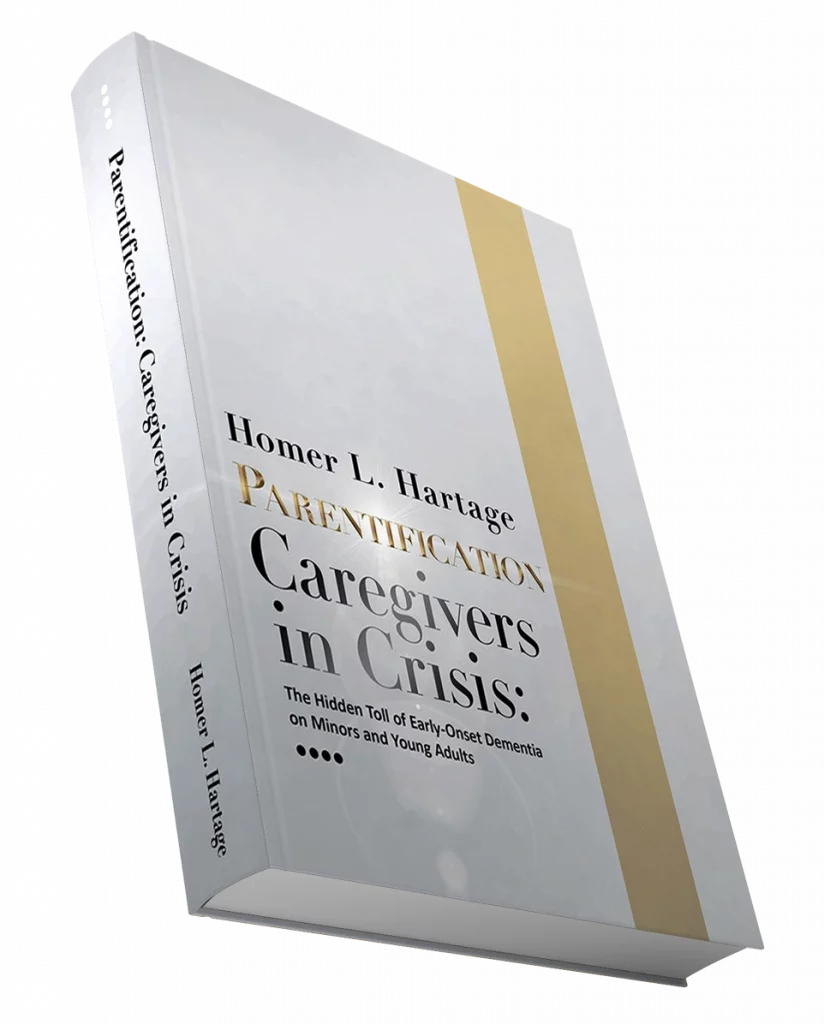
Parentification: Caregivers In Crisis
Every day, countless children step into roles meant for adults. Behind that strength lies a hidden cost: the loss of childhood, unspoken stress, and emotional wounds that can last a lifetime.
When Children Carry Adult Responsibilities
This book shines an unflinching light on the emotional and psychological weight carried by children who are forced to grow up too soon.