
Parentification Resource Center
Why This Book Is Important. Why Now.
Every field of caregiving research eventually produces a moment where the data catches up to what families have quietly known for years. For young caregivers of parents with early onset dementia, that moment is happening right now, and the systems built to support families are still years behind it.
The Numbers Are Bigger Than Most People Assume
If you have ever tried to find a single, clean number for “how many minors are caregivers in the United States,” you have probably noticed the figures do not agree with each other. That is not because the problem is small. It is because the country still lacks consistent, nationwide measurement built to capture caregiving among minors in the first place.
A federal review estimates that roughly 3 to 5 million minors may be acting as caregivers, a population large enough to matter for schools, clinics, and first responders as a routine reality, not a rare exception. A nationally representative analysis using time use survey data found that, on average per year, about 9.2 percent of 15 to 18 year olds and 12.7 percent of 19 to 22 year olds were providing regular assistance to an adult with daily living needs. When Florida asked the question directly in its own schools, 24 percent of middle schoolers and 16 percent of high schoolers reported providing care at least once a week, a figure that extrapolated to more than 290,000 caregiving youth in that state’s public schools alone. Other research puts the number of children aged 8 to 18 providing this kind of care at roughly 1.4 million nationally.
These numbers do not agree with each other because they are measuring slightly different things, in different ways, at different ages. That disagreement is itself part of the story. A population this large should not still be this hard to count.


The Research Has Not Kept Pace
A scoping review of United States based research on youth caregivers found only four new American studies published since 2015, alongside persistent inconsistency in how researchers even define the term. Compare that to the volume of research on adult and spousal caregivers, an entire field with established measurement tools, established support programs, and established policy language, and the gap becomes stark. Young caregivers have existed the entire time. The research and the systems built around them have not caught up.
This matters practically, not just academically. When a field lacks consistent terminology and consistent data, it also lacks the political and institutional weight needed to build real support: dedicated funding streams, school protocols, clinical screening tools, workplace accommodations. Invisibility in the data becomes invisibility in the response.
Why Early Onset Dementia Specifically Raises the Stakes
Most caregiving research and most caregiving support services were built around a spousal caregiver: someone in their 60s or 70s caring for a partner. Early onset dementia breaks that assumption at its foundation. When dementia arrives in a parent’s 40s or 50s, the person most consistently present in the home is frequently not a spouse with authority, income, and decades of experience navigating adult systems. It is a teenager, doing the same caregiving tasks with none of that standing.
This is a genuinely different population living through a genuinely different version of the same disease, and the systems built for the spousal caregiver model simply do not fit. A support program designed around a 68 year old caregiver who drives, controls household finances, and can take time off work does not translate cleanly to a 15 year old managing the same responsibilities from a bedroom between homework assignments.

Why This Moment, Specifically
Several trends are converging right now in a way that makes this book, and this hub, timely rather than simply overdue.
Youth mental health is already at a documented crisis point. National survey data shows roughly 20 million young people living with a diagnosable mental health disorder, alongside a well documented rise in adolescent anxiety and depression over the past decade. Young caregiving is not the only driver of that trend, but for the millions of teenagers quietly managing a parent’s cognitive decline, it is very likely an unmeasured contributor sitting inside that larger number, unnamed and unaddressed.
Policy attention is finally starting to catch up, but slowly. Recent federal review has explicitly called for clarification of youth eligibility for caregiver support programs, and has acknowledged the shortcomings in how national data systems capture this population. That kind of institutional attention did not exist in a serious way even a decade ago. The door is open. It has not been walked through yet.
Global research is starting to confirm this is not a uniquely American pattern. A systematic review covering nearly a hundred studies on parentification during the COVID-19 period found consistent global patterns across very different countries and health systems, alongside recurring themes of resilience, and recurring gaps in support. Family structures are changing everywhere, and dementia is arriving earlier in more families than most public health planning has accounted for.
Employers are quietly absorbing costs they cannot yet name. Research on unpaid caregivers more broadly finds that roughly one in three caregivers under 50 are also supporting children of their own, with early evidence pointing to real productivity costs, missed hours, and burned out student workers, sitting largely outside standard workplace policy. Businesses are already living with this. Very few have a framework for addressing it.
Terminology itself is only now catching up to lived experience. For most of the twentieth century, a child running a household because a parent could not was simply called mature, responsible, or a good kid. Parentification is a relatively recent clinical term for an old, widespread pattern. Naming it publicly, clearly, and specifically in the context of early onset dementia, rather than folding it into a vague general category of family stress, is what allows recognition, screening, and support to actually happen.
Why This Particular Book
Most existing caregiving literature falls into one of two categories: clinical research written for other researchers, or memoir written for general audiences without a clear path to action. Parentification: Caregivers in Crisis was written to sit deliberately between those two categories, grounded in the actual research base described above, but written in plain language for the people who need it most urgently: the young caregivers themselves, and the parents, teachers, clinicians, employers, and policymakers who are in a position to lighten their load.
It also comes from firsthand experience on both sides of this problem, as someone who was a young caregiver himself long before there was a clinical word for it, and later, as a professional guardian, sitting directly across from a family living through exactly this crisis in real time.
If the statistics above describe a population in the millions that research has only recently begun to measure accurately, then a book willing to name the problem plainly, and offer a concrete way through it, is not simply timely. It is overdue.
Where to Go From Here
If you are trying to understand the basic concept first, start with What Is Parentification? Understanding the Hidden Role Reversal. If early onset dementia is the specific disease affecting your family, Early-Onset Dementia and the Caregiver Cliff explains why this particular illness accelerates the pattern so quickly.
To go deeper than any single article can, the full research base, case studies, and practical frameworks referenced throughout this hub are laid out in Parentification: Caregivers in Crisis.
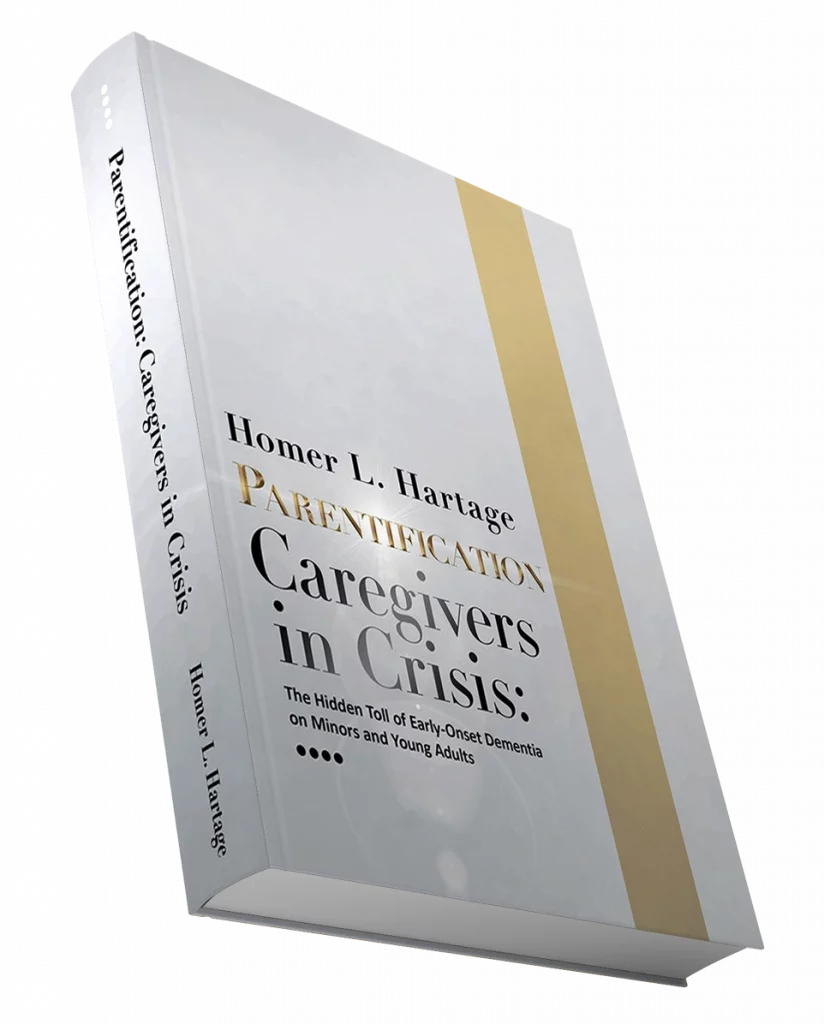
Parentification: Caregivers In Crisis
Every day, countless children step into roles meant for adults. Behind that strength lies a hidden cost: the loss of childhood, unspoken stress, and emotional wounds that can last a lifetime.
When Children Carry Adult Responsibilities
This book shines an unflinching light on the emotional and psychological weight carried by children who are forced to grow up too soon.