
Parentification Resource Center
What Every Teacher Should Know About Young Caregivers
A student who used to turn in every assignment on time starts drifting. A student who never missed first period starts arriving at 9:40 with a crumpled tardy slip and a look that says, don’t ask me anything. Someone falls asleep in class, head down, hoodie up, then snaps awake as if they’ve been caught doing something shameful. Another student keeps checking their phone, thumb moving fast, eyes flicking toward the door.
Teachers see “distracted.” Administrators see “noncompliant.” Peers see “weird lately.”
But inside that student, the story is often much simpler: I’m monitoring home.
The Behavior Is the Signal, Not the Story
Young caregivers face one of the sharper injustices in a school setting: their struggles frequently look like attitude. Their vigilance looks like disrespect. Their exhaustion looks like laziness. Because many young caregivers don’t disclose what’s happening at home, the adults who could help end up responding to symptoms instead of causes.
That means a school can end up punishing a student twice: once by the caregiving itself, and again by a system that reads their constraints as a choice.


What This Looks Like Academically
Caregiving doesn’t just take a student’s time. It takes their bandwidth, the mental space needed for attention, working memory, planning, and impulse control. When a student’s nervous system is scanning for problems at home, there’s simply less capacity left for algebra. When sleep is fragmented night after night, reading comprehension drops. When a student is living inside a repeating cycle of crisis, cleanup, brief calm, and the next crisis, long-term projects become genuinely difficult to sustain, not because the student doesn’t care, but because their week won’t hold still long enough to build consistent study habits.
In practice, this tends to show up as:
- Inconsistent performance, acing one test, struggling badly the next, which adults often misread as “not trying”
- Missed deadlines, not from procrastination, but because life at home is genuinely triage
- Attendance problems, especially in the morning, mornings are frequently when home routines break down and a caregiver is needed most
- Hypervigilance about their phone, for this student, the phone isn’t entertainment. It’s a lifeline to home.
A student can be intelligent, motivated, and still visibly struggling, because they’re operating on half a battery with a constant alarm running quietly in the background.
Why Schools Often Miss This
Most educators care and want to help. But schools are generally built to interpret behavior through a familiar set of categories: motivation, discipline, learning differences, family support. Young caregiving doesn’t fit neatly into any of them, and because it’s usually hidden, it’s easy to misread.
A few specific blind spots are worth naming directly:
The parent’s presentation can be misleading. A parent affected by early-onset dementia may seem articulate and put-together at a school meeting, especially in short interactions, while struggling significantly with planning, memory, or emotional regulation at home. That mismatch between what a school sees and what a student actually lives with is common, not rare.
Professionals are often, understandably, cautious about home-life questions. Teachers and staff frequently worry about overstepping, about safeguarding protocols, about making a misstep. That caution can quietly default into simply not asking, which means a school ends up unable to support what it never sees.
The “extra help” a school offers may not be accessible to this student. After-school tutoring and extracurricular activities work well for many students. For a young caregiver, “just stay a little later” can be genuinely impossible if someone at home needs them the moment school ends.


How to Ask Without Prying
Recognizing this pattern doesn’t require a formal diagnosis or a dramatic confrontation. A few things tend to work well in practice:
Start with function, not a label. Rather than asking directly, “Are you a young caregiver?” (which can feel exposing), try something like: “I’ve noticed mornings have been hard for you. Is there something outside of school making it harder to be on time?”
Offer an exit ramp. “You don’t have to share details. I’m not trying to get you in trouble. I’m trying to figure out what support would actually help.” That single sentence does a lot of work, it tells a guarded student that honesty won’t be met with punishment.
Treat a vague answer as real information. If a student says only, “It’s complicated at home,” that sentence is enough to act on. It doesn’t need to be pried open further in that moment.
A workable script: “I’m noticing you seem on-call for something during school. You don’t have to explain it to me. Would it help if we built a plan so you could check in once during second period, without getting in trouble for it?”
The goal isn’t to uncover a full story. It’s to reduce harm.
When a Student Asks You Not to Call Home
This is often the hardest moment for an educator: a student finally discloses something real, and then panics. “Please don’t call my mom. Please don’t make this worse.”
In that moment, it helps to slow down and be honest about what confidentiality does and doesn’t mean: “My job is to help keep you safe. That doesn’t automatically mean calling home right now. Let’s talk through what ‘safe’ actually looks like here.”
Often, a student isn’t afraid of their parent. They’re afraid of systems, afraid that being honest will set off a chain reaction they can’t control. That fear isn’t an overreaction. It’s usually based on real patterns they’ve seen play out for other families. A wise response holds two things at once: honoring the student’s fear and autonomy as much as possible, while staying clear-eyed about genuine safety and any mandatory reporting responsibilities. It responds with a plan, not a scramble.
A Practical Starting Point for Schools
- Observe patterns over time, attendance, sleepiness, sudden academic decline, phone hypervigilance, rather than reacting to a single incident.
- Document neutrally. “Student reports staying up to monitor a parent’s safety” is more useful, and fairer, than “parent is negligent.”
- Reach out with permission-based language, offering choices rather than demands.
- Build an accommodation pathway that doesn’t require disclosure, flexible deadlines, an attendance re-entry plan, a standing counselor check-in, a quiet space to decompress, or a structured, brief daily check-in for a student whose phone anxiety is rooted in real safety concerns at home.
A few intake questions worth having on hand for any student showing this pattern:
- “Who helps most at home when things get hard?”
- “Is there a minor providing regular help or supervision at home?”
- “Does caregiving ever interfere with your sleep, school, or work?”
- “Are there any safety-related tasks you’re handling, medications, night monitoring, crisis decisions?”
“Who is the adult we could coordinate with, so responsibility sits with adults rather than with you?”
This Connects to the Classroom Too
If your school already uses our Curriculum & Educator Resource Center to help younger students process a grandparent’s memory loss, this is the same underlying subject at a later, heavier stage: a family managing dementia, with a young person absorbing more of it than anyone realizes. Our Curriculum & Educator Resource Center offers classroom-ready material for younger students; this article is written for recognizing when an older student has moved from processing a family member’s illness to quietly managing it.
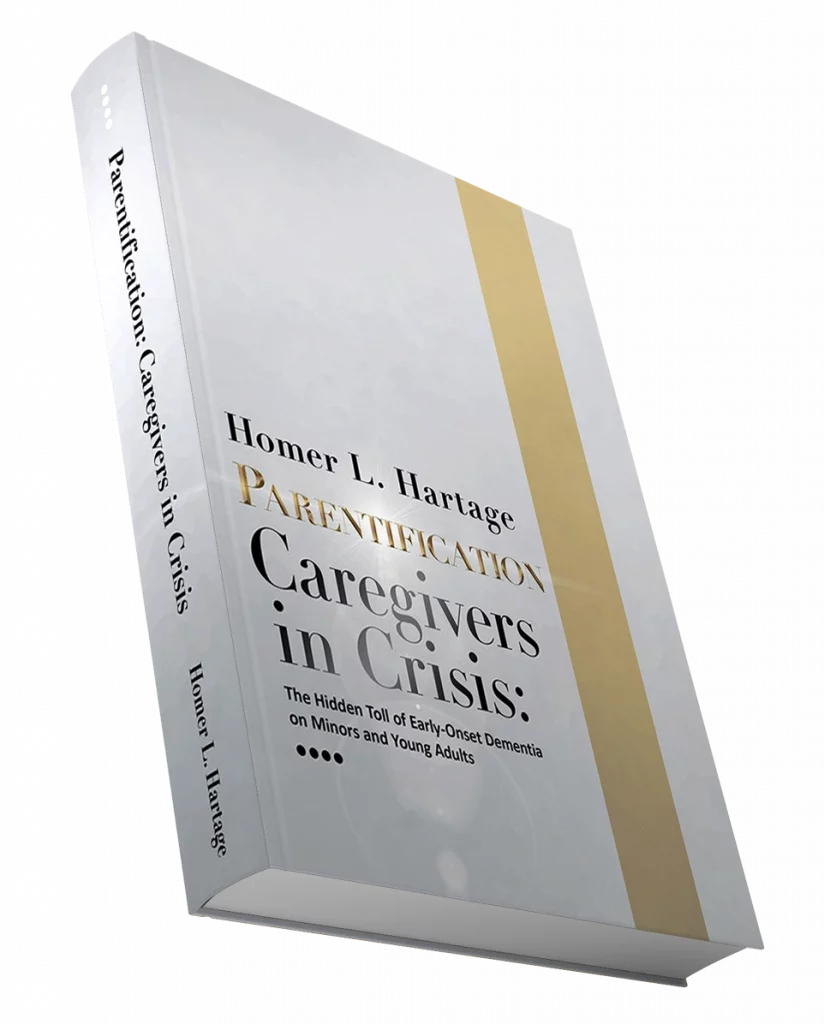
Parentification: Caregivers In Crisis
Every day, countless children step into roles meant for adults. Behind that strength lies a hidden cost: the loss of childhood, unspoken stress, and emotional wounds that can last a lifetime.
When Children Carry Adult Responsibilities
This book shines an unflinching light on the emotional and psychological weight carried by children who are forced to grow up too soon.